
TL;DR: AI search is changing where B2B buying decisions actually get made, 51% of B2B software buyers now start vendor research in an AI chatbot instead of a search engine, up from 29% a year earlier (G2, 2026). But there’s no single “AI algorithm” to optimize for; platforms retrieve information differently, pull from different sources, and play different roles depending on the buyer. This guide gives executives a mental model for AI visibility, presence, representation, consideration, and recommendation, explains why it’s structurally harder than SEO, and lays out the questions leadership should be asking before a competitor becomes the default answer in your category.
Chapter 1: A Question You Can’t Answer From a Dashboard
Ask your team where you rank on Google, and someone can pull up a report in five minutes. Ask your team what ChatGPT says about your company the next time a prospect asks it to recommend a vendor, and most will have no idea.
That gap is the subject of this guide.
It isn’t a gap in effort. It’s a gap in visibility into a channel that didn’t exist in its current form two years ago, is already shaping how buyers form opinions, and doesn’t show up in the reporting most companies still rely on.
Chapter 2: The Buying Journey Has a New First Step
According to G2’s 2026 Answer Economy report, a survey of over 1,000 B2B software buyers, 51% now begin vendor research inside an AI chatbot instead of a search engine, up from just 29% the year before.
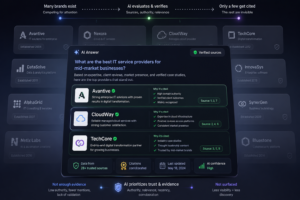
Buyers used to start with a search box and a list of blue links. Increasingly, they start with a question, “What are the best options for X?” “How does Company A compare to Company B?” “What are people saying about switching from X?”, and an AI system answers directly, with a handful of vendors named and the rest left out.
Nobody clicks through ten results anymore. There’s often nothing to click through. The AI has already done the comparing, and in many cases, the deciding. This changes what “being found” means. It used to mean ranking. Now it means being one of the names the AI chose to say out loud.
The distinction between traditional search-integrated AI and conversational AI is important. Google AI Search vs. ChatGPT explores how these experiences differ and why that matters for visibility.
Chapter 3: Why This Isn’t a Simple Fix
The instinct is to ask: “How do we optimize for ChatGPT?“, treating it like the next SEO checklist.
The honest answer is that there isn’t one system to decode. Google’s AI answers, ChatGPT, Perplexity, Copilot, and Claude each retrieve information differently, draw on different sources, and play a different role depending on the buyer and the industry. A tactic that lifts visibility on one platform can do nothing on another, and what works today can stop working the moment a platform changes how it retrieves information.
There’s no algorithm to reverse-engineer. Four things can shift under you at once, which is what makes this harder than traditional SEO ever was:
- The competitive set changes: A broad category question and a specific use-case question can surface entirely different companies.
- The sources change: One answer might lean on your website; another might lean on a review site or a community thread you’ve never touched.
- The answer itself changes: The same company can be described differently depending on the question, the platform, and what information the system had available.
- The platforms change: Retrieval systems get updated. Indexes shift. New AI products launch. A pattern that worked last quarter can quietly stop working.
There’s no algorithm to reverse-engineer here, only a discipline to build: understanding where your buyers actually form opinions, and doing the underlying work that makes your company easy for any AI system to understand, trust, and recommend. That’s a strategic capability, not a marketing tactic. Which is why it belongs on your desk, not just your marketing team’s task list.
Chapter 4: The Real Cost of Being Invisible
Three things happen when your company doesn’t show up in AI-generated answers, and none of them are visible in traditional analytics:
- You lose deals you never knew were in play. A prospect asks an AI to shortlist vendors. You’re not on it. You never see the lost opportunity because it never became a website visit, a form fill, or a pipeline entry.
- Competitors set the narrative. If they’re being named and you’re not, the AI is, by default, telling every buyer who asks that your competitor is the more credible option in your category.
- You get misrepresented, and don’t find out. AI systems synthesize whatever information exists about you across the web. If that information is thin, outdated, or inconsistent, the system fills gaps with its best guess — and its best guess about your positioning may not be one you’d sign off on.
None of this shows up as a line item until it’s already cost you a quarter’s worth of pipeline.
See what five practitioners identified as common reasons brands disappear from AI-generated answers
Chapter 5: What “AI Visibility” Actually Means
“Are we in ChatGPT?” is the wrong question, it only has a yes/no answer, and yes/no doesn’t tell you whether it’s helping. Visibility is a spectrum with six dimensions worth tracking:
- Presence: Do you show up at all for the questions buyers actually ask?
- Prominence: Are you recommended as a real option, or just mentioned in passing?
- Competitive share: When you’re absent, who fills the space instead?
- Source footprint: What’s actually feeding the AI’s understanding of you, reviews, press, docs, communities?
- Journey coverage: Do you show up only at discovery, or also when buyers compare, question, and validate?
- Platform coherence: Is your story consistent everywhere your buyer might ask, or does it shift depending on which AI they use?
A company can score well on one of these and still be losing deals on another. That’s why a single “are we visible” checkbox is close to useless as a metric. This is the problem AI Search Pulse is designed to measure.
Chapter 6: The Work That Moves All Six at Once
You don’t need six separate strategies. Every AI system, regardless of how it retrieves or ranks information, is trying to answer the same underlying question about your company: can this be understood, verified, and trusted enough to recommend?
That comes down to three things, at the leadership level:
Clarity. Can a system that has never met your sales team explain what you do, who it’s for, and how you’re different — using only what’s publicly available about you?
Evidence. Does the rest of the internet back up what your website says, or is your best marketing claim unsupported anywhere else?
Consistency. Does your story hold together everywhere it’s told, or does it depend on which page someone lands on?
Everything tactical, content, PR, reviews, structured data, third-party mentions, is in service of those three things. That’s the layer worth asking your team about; the execution detail is theirs to own.
Chapter 7: Six Questions to Bring to Your Next Leadership Meeting
- When a buyer asks an AI system to recommend our category, do we appear, and are we recommended, or just listed?
- Which competitors show up when we don’t, and why them?
- Is what AI systems say about us accurate, or has it filled in gaps with guesses?
- Do we know which sources, reviews, press, documentation, communities, are actually shaping how AI describes us?
- Are we visible only at the top of the funnel, or also when buyers are comparing us against alternatives?
- Who on our team owns this? (If the honest answer is “no one,” that’s the finding.)
See how AI Search Pulse measures visibility across real buyer questions
Chapter 8: The Window Won’t Stay Open
AI search is still early. The patterns each platform uses to decide who gets named are still forming, most competitors haven’t systematically addressed this yet, and category narratives are still being written in real time.
That window closes. As these systems mature, the brands already established in the answer will be harder to dislodge — the same way early SEO winners built a lead that took competitors years to close.
The question isn’t whether AI search will matter to your category. For most categories, it already does. The question is whether, when your buyers ask, your name is the one that comes back.
How Visible Is Your Brand in AI Search?
You don’t need another GEO checklist. You need to know where your brand appears, where competitors are winning, and what is influencing the answers buyers see.
Request your AI Visibility Score
See how your brand performs across the AI search journeys that matter to your business.