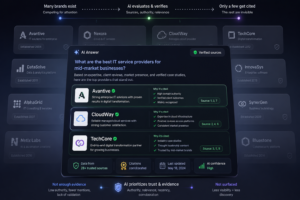

TL;DR
Your company may not appear in ChatGPT because AI systems do not yet have enough confidence about your brand, expertise, or relevance.
AI visibility depends on more than technical SEO. It is shaped by:
- Discoverability: Can AI systems access and retrieve your information?
- Content Entity Architecture: Does your website clearly communicate what you do and what you are known for?
- Multi-source trust: Do relevant external sources validate your expertise?
- Content clarity: Is your information easy for AI and humans to understand?
- Authority: Are there signals that your company is trusted within your category?
The goal is not to “optimize for ChatGPT.” The goal is to build a clear, trusted digital presence that AI systems can confidently recommend.
Last week, one of your prospects probably asked ChatGPT something like:
“What’s the best document processing software?”
or:
“Which platform should we consider for automating document workflows?”
You probably won’t know whether your company was mentioned. What you may notice later is fewer inbound conversations, buyers who already know your competitors, and sales teams working harder to explain why your company deserves consideration.
That is what makes AI visibility different from traditional SEO.
When you lose rankings on Google, you usually see the impact. When you disappear from AI-generated recommendations, the loss often happens quietly.
AI visibility is not about chasing a new marketing trend. It is about making sure your business remains discoverable as the way people research products and make decisions changes. The good news is that AI visibility is not random. Companies usually become invisible because one or more trust layers are missing.
This guide explains those layers and helps you understand where the problem may exist.
Why most AI visibility advice misses the bigger picture
Search for “how to get cited in ChatGPT” and you will find the same recommendations repeated:
- Add schema markup.
- Build backlinks.
- Create FAQs.
- Post on Reddit.
- Publish more content.
None of these are bad advice. But they are only pieces of a much bigger picture. Think about how you personally recommend a product. You don’t trust a company because it has FAQ schema. You trust it because you understand what the company does, you see evidence that others trust it, and you can confidently explain why it is a good option.
AI systems work in a similar way. They build confidence from multiple signals. The real question is not:
“What is the one thing I need to optimize?”
The better question is:
“Which trust layer is preventing AI systems from confidently understanding and recommending my company?”
The AI Visibility Layers
Layer 1: Can AI retrieve and understand your information?
Before AI can recommend your company, it needs to discover your information. Modern AI search experiences often rely on retrieval systems that identify relevant information before generating an answer.
If your important pages are difficult to discover, poorly connected, outdated, or technically inaccessible, they have fewer opportunities to become part of that process.
This includes fundamentals such as:
- Search engine indexing
- Crawlability
- Website accessibility
- Content freshness
- Clear site structure
One area many companies overlook is Bing.
Google remains the dominant search engine, but Bing plays an important role in Microsoft’s AI ecosystem and contributes to some AI-powered search experiences. This does not mean you need a completely separate Bing SEO strategy. It means your company should not assume Google visibility automatically translates into AI visibility.
Ask yourself:
- Is my website discoverable beyond Google?
- Are important pages indexed properly?
- Can search systems easily understand my website structure?
If the answer is unclear, this is the first layer worth investigating.
Layer 2: Does AI understand what your company actually represents?
This is where many companies struggle. Most businesses think about content as a publishing exercise:
“How many blog posts can we create?”
AI visibility requires a different question:
“Does our entire website make our expertise obvious?”
This is where Content Entity Architecture becomes important.
Content Entity Architecture is the way your website organizes relationships between:
- Your products
- Customer problems
- Industry concepts
- Use cases
- Supporting educational content
- Proof of expertise
Imagine two document processing companies.
Company A
They have 300 articles covering:
- AI trends
- Productivity
- Remote work
- Leadership
- Automation
- Business advice
- Digital transformation
They publish frequently, but their expertise is scattered.
Company B
They have 80 articles focused on:
- Intelligent Document Processing
- OCR technology
- Invoice automation
- Document classification
- Data extraction
- Enterprise workflows
- Compliance requirements
Their content consistently reinforces the same knowledge area. Which company is easier for AI systems to understand as a document processing expert?
Usually, the second one. Not because they have more content. Because their knowledge structure is clearer. Traditional SEO often focuses on creating pages that rank.
AI visibility requires creating a connected knowledge system that helps AI understand:
- What you do
- Who you serve
- What problems you solve
- Why your company should be trusted
Layer 3: Can AI verify your expertise beyond your website?
Your website tells people who you are. The rest of the internet helps confirm whether that is true. AI systems do not need to see your company everywhere. They need consistent signals from relevant sources.
These signals can include:
- Customer case studies
- Industry publications
- Partner websites
- Expert contributions
- Podcasts
- Conference appearances
- Documentation
- Educational resources
- Product comparisons
The goal is not maximum presence. The goal is meaningful presence. A developer tool may benefit from GitHub and technical communities.
An enterprise SaaS company may benefit more from customer stories, industry reports, and trusted publications. The right sources depend on where your buyers actually look for information.
Do you need Reddit, G2, or Capterra to appear in AI answers?
This is one of the most misunderstood areas of AI visibility. You will often hear:
“You need Reddit.”
“You need G2.”
“You need to be everywhere.”
The reality is more nuanced. These platforms can be valuable, but only when they align with your buyer journey. If your customers compare software on G2, then having a strong presence there may matter. If your buyers rely on analyst reports, industry communities, technical documentation, or peer recommendations, those may be more important.
The goal is not to collect profiles on every platform. The goal is to build trust where your customers naturally validate decisions. Following every AI search trend without understanding your audience usually creates activity, not results.
Layer 4: Is your content easy for AI to understand and reference?
Even if AI discovers your company and understands your expertise, your content still needs to communicate clearly. AI systems perform better when information is structured and easy to interpret. This does not mean writing for machines. It means removing unnecessary confusion for humans and AI.
Helpful content often includes:
- Clear definitions
- Direct answers
- Comparison tables
- FAQ sections
- Original research
- Supporting evidence
- Specific examples
- Descriptive headings
For example:
A page explaining “What is intelligent document processing?” should not hide the answer after five paragraphs of marketing language. It should clearly explain the concept, define important terms, provide examples, and connect the topic to your expertise.
Clear information creates stronger understanding.
Layer 5: Are you building authority, or just collecting backlinks?
Backlinks still matter. They remain an important way websites and search systems understand trust. But backlinks are only one part of authority. Strong authority is built through a combination of:
- Original research
- Expert insights
- Industry mentions
- Digital PR
- Customer success stories
- High-quality references
- Trusted relationships
The strongest AI-visible brands are not simply collecting links. They are becoming sources that others naturally reference.
Layer 6: AI search is not the same as Google search
For years, marketers asked:
“How do we rank higher?”
AI search changes the question. Now businesses need to ask:
“How do we become a trusted source when AI creates an answer?”
Traditional search often focuses on ranking individual pages. AI systems need to understand the broader context:
- What is this company?
- What does it specialize in?
- Is the information consistent?
- Can it be trusted?
- Does it match the user’s question?
This is why AI visibility requires a combination of content, authority, and brand understanding.
Layer 7: Are you monitoring your AI visibility?
Many companies optimize once and assume the problem is solved. But AI visibility changes. Competitors publish new content. Models change. Buyer questions evolve.
Your visibility today may not be your visibility six months from now. Monitoring helps answer questions like:
- Are we appearing for important buyer questions?
- Which competitors appear more often?
- Which sources are influencing AI answers?
- Are our improvements working?
Without measurement, AI visibility becomes guesswork.
AI visibility is a silent growth problem
The hardest marketing problems are often the ones you cannot immediately see. If your website goes down, you know. If your rankings disappear, analytics show you.
But if AI assistants consistently recommend competitors while leaving your company out, there may be no obvious warning. The lost opportunity happens before someone ever reaches your website.
- A buyer creates a shortlist.
- A competitor gets mentioned.
- A conversation begins.
- And your company is not part of it.
- That is why AI visibility deserves attention—not because AI will replace every marketing channel overnight, but because buyer research behavior is changing quietly.
A simple AI Visibility Check
Ask yourself:
✅ Can AI systems discover our important information?
✅ Does our website clearly communicate our expertise?
✅ Is our content organized around strong entities and relationships?
✅ Are we visible beyond our own website?
✅ Are we present where our buyers validate decisions?
✅ Is our content structured clearly enough to be understood?
✅ Are we monitoring how AI systems represent our brand?
If several answers are uncertain, you may have an AI visibility problem.
Frequently Asked Questions
Why isn’t my company showing up in ChatGPT?
Usually, there is not one single reason. AI visibility depends on multiple signals, including discoverability, content structure, authority, and external validation.
Does ChatGPT use Bing?
Some ChatGPT search experiences use Bing as part of the retrieval process, but ChatGPT does not simply copy Bing rankings. Improving Bing discoverability can still help your overall AI search presence.
Is Content Entity Architecture the same as topical authority?
They overlap but are not identical. Topical authority focuses on covering a subject deeply. Content Entity Architecture focuses on organizing your website so AI systems can understand the relationships between your expertise, products, topics, and customer needs.
Do backlinks matter for AI visibility?
Yes, but they are one signal among many. Strong AI visibility comes from a combination of authority, relevance, discoverability, and consistent information across trusted sources.
Does every company need Reddit or G2?
No. The right platforms depend on where your customers research and validate decisions.
How do I measure AI visibility?
You need to track whether your brand appears for important buyer questions, how often competitors appear, what sources influence AI answers, and how visibility changes over time.
Start by finding what is missing
The challenge is not simply knowing that your company is missing from ChatGPT. The challenge is understanding why. A strong AI Visibility Audit should identify which trust layer is limiting your visibility, from discoverability and Content Entity Architecture to authority and multi-source presence.
Instead of making random changes, you get a clear picture of where your company stands, where competitors are stronger, and which improvements are most likely to increase your visibility.
Because the goal is not just to appear in AI answers. The goal is to become the company AI systems confidently recommend when your future customers ask:
“Who should we choose?”