
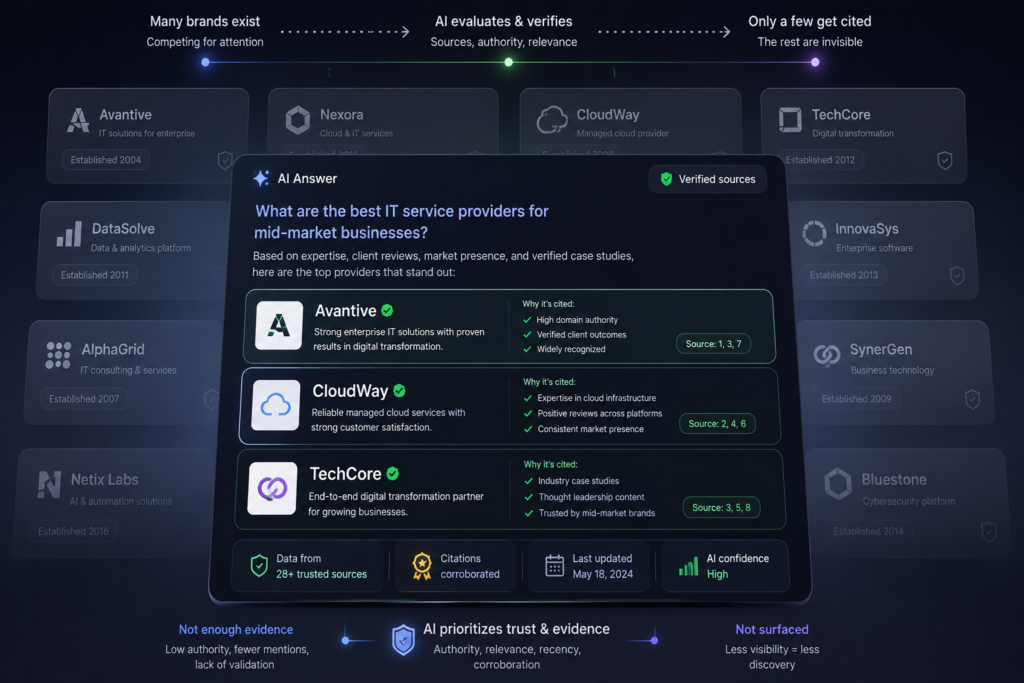
We put this question to a handful of founders and marketers: why do some brands get cited by AI answer engines while others, doing seemingly the same work, don’t? The answers came from different industries; SEO, insurance, SaaS research, QR codes, law firm marketing, but they weren’t five versions of the same answer. They were five different failure points, each experts have observed firsthand.
One caveat before we get into it: “AI” isn’t one system. ChatGPT, Gemini, Claude, and Google’s AI Overviews retrieve and synthesize information differently, and none of us has access to how any of them actually weight their sources. What follows is what five practitioners have observed in their own results, real, specific, and worth taking seriously, but their interpretation of why it works, not a confirmed mechanism. We’ve flagged that distinction throughout.
TL;DR
- Structure matters. Content buried under vague headings, with no clear self-contained answer, is harder for any answer engine to lift and cite.
- “AI SEO” isn’t a separate discipline. The experts we spoke with see this as fundamentals, schema, crawlability, page speed, not a new acronym to chase instead of them.
- Breadth over depth seems to backfire. Several experts independently reported better results from narrow, precise pages than broad ones.
- External mentions seem to help. Multiple experts believe being referenced in roundups, comparisons, and editorial content matters as much as anything published on-site, though none of us can confirm the exact mechanism.
- Consistency was a recurring theme. The same brand facts, worded the same way, across every place they appear.
- Google rank and AI citation aren’t the same thing. You can have one without the other.
Try this yourself
Pick 10 real questions your buyers ask (“best CRM for a small sales team,” “alternatives to X for a growing company”). Run each one through ChatGPT, Gemini, Claude, and Google. Note who gets mentioned and what sources back them up. Repeat monthly. It’ll tell you more than asking “does ChatGPT know my brand?”
Bree Sharp: make your content extractable
Bree Sharp is a freelance SEO consultant working out of Olive Hill, Kentucky. Her core idea is about structure, not quality: most companies aren’t invisible to AI because their content is bad, they’re invisible because there’s nothing a model can cleanly lift out of it. An AI isn’t reading a page the way a person does, it’s hunting for a self-contained answer it can extract, attribute, and stand behind. Bury your best line three paragraphs into a section called “Our Approach,” and there’s nothing to lift.
She sees two mistakes over and over:
- Treating “AI visibility” as its own separate channel. Buying AI-optimization services while the site itself still loads slowly, has no schema, and a title tag that just says “Home.” Her comparison: a roof rack for a car with no engine.
- Chasing volume instead of depth. Ten thin posts a week haven’t earned citations for the sites she’s worked on. One page that nails a specific question tends to outperform them.
What moved things for her own site: rewriting sections so each one answers a single question in its first two sentences, tightening entity signals (consistent name/address/phone, schema, a real About page), and building corroboration off her own domain. Her interpretation of why the last one worked, that models trust agreement between independent sources more than anything a brand says about itself — is her theory based on her results, not something either of us can verify from the outside.
She also shared a specific number: her site moved from roughly position 17 to position 1 for “freelance seo consultant Kentucky” in about three weeks, and now appears in Google’s AI Overview for that term.
Brian Hansen: get specific instead of sounding big
Brian Hansen is president of Rocket Pilots, a San Diego agency that’s spent close to a decade helping law firms turn online visibility into actual case volume. His diagnosis centers on differentiation: the companies struggling most with ChatGPT visibility are, in his experience, still publishing for the algorithms of a decade ago, chasing volume, broad terms, and shallow coverage. A site can have plenty of indexed pages and still be absent from AI-generated answers if none of them establish anything distinct.
What’s worked for his agency’s clients: narrow topical depth instead of broad coverage, named individual experts instead of an anonymous “our team,” consistent brand facts, and third-party reinforcement. His summary line, and it’s a good one: brands improve their visibility when they stop trying to sound big and start trying to sound unmistakably useful.
Suggested Read: Why Isn’t My Company Showing Up in ChatGPT? A Founder’s Guide to AI Visibility
Siim Kostabi: your own site is only half the picture
Siim Kostabi runs content at Pageloot, a QR code platform used in over 110 countries. His angle: the mistake isn’t technical, it’s an assumption. Brands write for Google’s crawler and assume ChatGPT or Gemini will follow the same rules. In his experience, they don’t — AI tools lean on what other people say about a brand, so you can rank well on Google and still be absent from AI answers if nobody outside your own site is talking about you.
What’s worked for Pageloot: getting mentioned in content that’s already established as trustworthy; “best tools” lists, editorial reviews, industry roundups, and keeping the brand description identical everywhere it appears. His theory that AI models “pattern-match” consistency, and that mismatched descriptions across sites work against a brand, is his read on his own results rather than a confirmed mechanism. He also noted something more concretely testable: short, direct answers in their own content get quoted more often than long narrative pieces.
Daniel Ray: build a body of expertise, not a keyword list
Danny Ray founded PinnacleQuote Life Insurance Experts. His pushback is on the assumption that a strong Google ranking automatically transfers to AI trust, it doesn’t, in his experience. AI visibility comes down to whether a company has built clear, consistent signals, on its own site and across the wider web, solid enough that its expertise reads as obvious rather than implied.
His approach: build content around the actual questions real customers ask, back claims with real sources, connect articles to each other so the expertise reads as a body of work, and let direct experience show instead of writing generic keyword-driven content. He weights third-party mentions heavily, when reputable outlets keep associating someone with a topic, that’s authority that’s hard to fake by writing about yourself. His bottom line: stop optimizing for keywords, start building a reputation that’s hard to leave out.
Khyati Sharma: think like the researcher checking your work
Khyati Sharma is Founder and Editor-in-Chief of TrulyCritic, an independent B2B software comparison site. She came at this from the researcher’s seat rather than the brand’s. When her team evaluates a SaaS product for a comparison guide and the site has a vague homepage, unclear pricing, and almost no independent coverage, it takes real effort just to answer basic questions: Who is this actually for? What does it cost? How’s it different from the other tools we’re comparing it to?
Her point: AI systems run into the same wall her research team does. Publishing more content doesn’t fix that if the fundamentals — clear category, use cases, honest pricing, real points of difference, aren’t established first. Only after that is it worth chasing evidence outside the company’s own site: editorial mentions, expert contributions, original research, consistent info across sources.
She also gave us the DIY test in the TL;DR above: take ten real buyer questions, run them across ChatGPT, Gemini, Claude, and Google, and track which brands and sources come up. Repeated monthly, it’s a more useful signal than asking an AI if it’s heard of you.
Suggested Read: How to Get Cited in ChatGPT: The 3R Framework for B2B SaaS
Actionable Takeaways
If you only do five things after reading this:
- Audit one page. Take your most important service or product page. Can you find the answer to its main question in the first two sentences of any section? If not, rewrite it so you can.
- Run the ten-question test. Ask your top 10 buyer questions across ChatGPT, Gemini, Claude, and Google. Write down who gets mentioned and where those mentions seem to come from.
- Check your consistency. Pull up how your brand is described on your own site, LinkedIn, any directory listings, and any press mentions. Fix the ones that don’t match.
- Find one roundup or comparison you’re missing from. Pick a “best tools for X” or comparison piece in your space that doesn’t mention you, and pitch your way in.
- Narrow one page instead of broadening it. Take a page that’s trying to cover too much ground and cut it down to one precise, hard-to-confuse-with-a-competitor answer.
The pattern across all five
There isn’t one AI ranking system, and none of these five have access to the actual retrieval logic behind ChatGPT, Gemini, Claude, or Google’s AI features. What they have is repeated, hands-on experience with what tends to correlate with getting cited. Two threads ran through all five conversations:
- Fix the fundamentals before chasing the acronym. Schema, crawlability, clear information about who you are, and content structured so a single section can stand alone as a full answer.
- Your own site is only half the picture. What other people say about you, consistently, across independent sources, seems to matter as much as anything you publish yourself; though exactly how much weight any given AI system places on that is something only the model builders can say for certain.
None of this is a hack. It’s close to what earning trust has always required. There’s just a machine reading the evidence now, alongside the people.
How we verified these
- Bree Sharp: Confirmed as a real, practicing SEO consultant based in Eastern Kentucky, via her local Chamber of Commerce listing and her own site; her site does currently rank prominently for “freelance seo consultant Kentucky.” Not independently verifiable: the week-by-week ranking history, which lives only in her own analytics.
- Brian Hansen: Confirmed as founder and president of Rocket Pilots via Crunchbase, multiple podcast interviews, and client reviews on independent review platforms. The agency has operated since 2016 with a consistent focus on law firm marketing.
- Siim Kostabi: Confirmed via Pageloot’s own published pages and his role as Content Lead there. Not independently verifiable: the “110 countries” and “20,000+ brands” figures, which are self-reported by the company.
- Danny Ray: Confirmed as founder of PinnacleQuote and corroborated by citations in Forbes, Yahoo Finance, MarketWatch, and Nasdaq — the most externally documented of the five contributors here.
- Khyati Sharma: Confirmed via her own LinkedIn activity and TrulyCritic’s active publishing history; it’s a real, currently operating comparison site with a substantial catalog of guides.
Sources: contributor comments and interviews shared for this piece. Verification notes for each contributor are included in their section above; where a specific figure or timeline was self-reported and not independently confirmable (e.g., internal ranking histories, brand-reported usage stats), that’s noted explicitly rather than presented as verified.