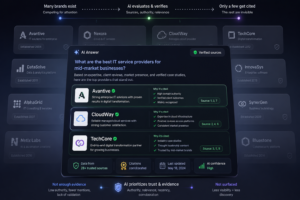

TL;DR
- Google AI Search and AI assistants are not the same channel. Google AI Overviews and AI Mode are embedded in Search; ChatGPT, Gemini, Claude and Perplexity increasingly act as conversational research and recommendation engines.
- AI visibility is no longer just about ranking. Google can select sources for an AI-generated answer, while assistants can influence which brands make a customer’s shortlist.
- Query intent matters more than a single AI Overview percentage. Comparison, review, question, pricing and “best” searches are particularly exposed to AI-generated answers.
- B2B is especially vulnerable. G2’s 2026 research found that 51% of B2B software buyers start research with AI chatbots more often than Google, and 69% say AI guidance has influenced them to choose a different vendor.
- The fundamentals overlap. Technical SEO, topical relevance, original evidence, clear product information and strong entity signals help across AI Search and AI assistants.
- The weighting is different. Google needs to understand and retrieve your information; AI assistants increasingly need enough information and evidence to confidently recommend you.
- The new question isn’t only “Can we rank?” It’s “When an AI is asked which companies should be considered, why would it choose us?”
Why Are Marketers So Focused on ChatGPT?
For the past year, one question has become almost unavoidable in marketing meetings:
“Why isn’t ChatGPT recommending us?”
It’s a reasonable question. ChatGPT has more than 900 million weekly users, and AI-generated referrals are now measurable across millions of websites. But the focus on ChatGPT has created a blind spot.
While marketers are trying to understand why their brand isn’t appearing in ChatGPT, Google has been putting AI directly into the search experience that billions of people already use.
Google says AI Overviews now reach more than 2.5 billion monthly active users, while AI Mode has surpassed 1 billion monthly users. AI search is therefore no longer a separate experiment happening somewhere outside traditional search.
Google has made it part of Search itself. The mistake is treating all of this as one category called “AI search.” There are actually two related but different visibility problems.
How Is Google AI Search Different From ChatGPT and Other AI Assistants?
Google AI Overviews and AI Mode start inside a search environment. The user asks a question, Google retrieves information and can synthesize it into an answer with supporting sources.
AI assistants start more conversationally. A user can describe a problem, add constraints and ask the system to compare or recommend options.
| Google AI Search | AI Assistants | |
| Examples | AI Overviews, AI Mode | ChatGPT, Gemini, Claude, Perplexity |
| Starting point | Search query | Conversational problem |
| Primary job | Retrieve and synthesize | Research, compare and recommend |
| Business objective | Become a cited source | Become a credible option |
| Key question | “Can this source help answer the query?” | “Which option best fits the user’s needs?” |
The distinction is subtle but important. Google increasingly determines which sources contribute to the answer. AI assistants can increasingly influence which businesses make the shortlist. The optimization signals overlap, but they are not identical.
How Big Is AI Search Compared With Traditional Search?
Standalone AI assistants are still much smaller than Google Search when measured by overall web activity. Similarweb’s May 2026 estimates put monthly web visits at approximately 5.57 billion for ChatGPT, 2.90 billion for Gemini and 953 million for Claude. These are web visits, not unique users, and shouldn’t be directly compared with Google’s or OpenAI’s active-user figures.
The important point isn’t that AI assistants have overtaken traditional search. They haven’t.
The important point is where in the customer journey AI is gaining influence. A customer may use Google to discover a category, then use ChatGPT or Gemini to compare vendors, then return to Google or visit a brand directly.
The AI interaction may therefore influence the purchase without generating the largest share of the eventual website traffic. That makes traffic share an incomplete way to measure AI’s commercial importance.
How Often Do Google AI Overviews Appear?
There isn’t one universal AI Overview trigger rate. Different studies use different query sets, industries, countries and methodologies.
What matters more is search intent. Seer Interactive’s research found particularly high AI Overview prevalence for queries involving comparisons, reviews, questions, pricing and “best-of” searches:
| Query type | AIO prevalence in Seer’s dataset |
| Comparison | ~95% |
| Review | ~86% |
| Question | ~86% |
| Price / cost | ~83% |
| Best-of | ~81% |
A separate 2026 academic study of 55,393 queries found AI Overviews on about 13.7% of queries overall, but the rate increased to 64.7% for question-form queries. These figures aren’t contradictory. They illustrate why a single “AIO penetration rate” can be misleading.
The more useful question is:
- Which searches that matter to my business are now being answered by AI?
For businesses with consideration-heavy buying journeys, this is particularly important because their highest-value searches often involve exactly these intents: comparisons, reviews, pricing, questions and recommendations.
Why Do Some Competitors Appear in AI Overviews Even When They Don’t Rank Highly?
This is where AI search becomes particularly interesting for SEO teams. A traditional SEO audit asks:
“Who ranks on page one?”
An AI-search audit needs another question:
“Which sources does the AI choose to construct the answer?”
Research has found that a meaningful proportion of domains cited in AI Overviews do not appear on Google’s first traditional results page. That doesn’t mean rankings no longer matter.
It means AI citation isn’t simply traditional ranking with an AI summary added on top. The system has a different task: finding information that helps answer the particular question.
This creates situations where a smaller competitor can be cited because its website provides clearer or more relevant information about the specific subject being answered. For marketers, that changes the diagnostic question.
Instead of asking:
“Why does Google like them more?”
Ask:
“What information does their web presence make easier for an AI system to establish?”
That could be their product capabilities, pricing, use cases, customer segment, comparisons, integrations, limitations or independent evidence. The opportunity is not necessarily to copy the competitor’s content. It is to make your own business equally clear, specific and verifiable.
What Information Does an AI Need to Understand and Recommend a Business?
This is where “AI optimization” often becomes complicated. The fundamental issue is information transparency. An AI system has difficulty evaluating a business when important facts are missing, ambiguous or inconsistent.
For a product company, commercially important information such as what the product does, who it is designed for, pricing, specifications, integrations, limitations and differences from alternatives needs to be clearly available and kept current.
For a service business, the equivalent information might include target customers, geographic coverage, areas of expertise, pricing model, outcomes and supporting evidence.
The principle is straightforward:
Don’t make the AI infer your value proposition when you can state it clearly.
This matters for both Google and AI assistants. The difference is what the system does with that information. Google may use it to construct an answer and cite your page. An AI assistant may use it to decide whether your company belongs in the shortlist.
Why Does Third-Party Reputation Matter for AI Visibility?
Your website tells an AI what you say about yourself. Independent sources provide evidence of how the market describes you. That distinction matters when an AI system has to choose between several similar companies.
If two software companies make similar claims on their own websites, but one is also consistently represented in independent reviews, comparison articles, customer discussions and industry publications, the second company gives an AI more external evidence to work with. This is why AI visibility cannot be treated purely as an on-site SEO exercise.
Your off-site reputation increasingly becomes part of your machine-readable market position.
The goal isn’t to manufacture mentions. It is to ensure that credible third-party sources accurately reflect what your company is actually good at.
Why Is B2B Software Particularly Exposed to AI Search?
B2B software has an unusually high concentration of questions that AI systems are designed to answer:
- Which platform is best for this company?
- What are the alternatives?
- How does X compare with Y?
- Which product integrates with our existing stack?
- Which vendor is best for a mid-market company?
- What does implementation involve?
These are not simply information queries. They are vendor-selection queries. And that brings AI visibility much closer to revenue.
G2’s 2026 research found that 51% of B2B software buyers start their research with AI chatbots more often than Google, while 71% use AI chatbots somewhere in the research process.
Most importantly, 69% said AI guidance influenced them to choose a different vendor than they originally intended. That means AI isn’t simply becoming another source of website traffic. It can influence which companies enter the consideration set in the first place.
What Does This Mean for B2B SEO and Content Strategy?
The answer isn’t to produce hundreds of pages labelled “AI optimized.” B2B companies need to make the information required for vendor evaluation clear, complete and independently supported.
A buyer, and therefore an AI system; should be able to establish your capabilities, integrations, pricing, implementation requirements, security, target customer, limitations and differences from alternatives without having to reconstruct the answer from scattered marketing pages.
This is also why comparison content matters. A company that only publishes “Why choose us?” content controls the narrative from one side. A company that clearly explains when its product is a good fit, when another solution may be better, how it compares with alternatives and what trade-offs buyers should understand provides information that is much more useful during an AI-assisted buying journey.
The objective isn’t to persuade the AI. It is to give it enough accurate information to make a defensible recommendation.
Why Are Product Specifications and Pricing Becoming More Important for AI Recommendations?
The same principle applies to D2C and ecommerce. Traditional search can send a consumer to a product page and let the consumer perform the comparison. A conversational AI can potentially perform much of that comparison before the consumer visits the website. Consider a request such as:
“Find me a carry-on under $250 that’s lightweight, durable and suitable for international flights.”
The AI needs to understand which products meet those constraints. That makes product specifications, pricing, availability, compatibility, use cases and meaningful differentiation much more important as machine-readable information.
The strategic shift is:
Don’t just optimize the product page to rank. Make the product understandable as an option. This is especially important as AI moves from answering “what is this?” toward answering “which one should I buy?”
How Does AI Search Change the Economics of the Click?
AI can reduce the number of traditional organic clicks while increasing the importance of being selected as a source. Seer’s research found that pages cited inside AI Overviews generated substantially more organic clicks per impression than uncited pages on the same results page — in its 2026 analysis, approximately 120% more organic clicks per impression for cited brands.
The broader lesson is more important than the exact percentage. The click pool may become smaller, but visibility inside the answer can determine who gets the remaining attention. That creates a new competitive scenario:
Competitor: appears in the AI answer → receives brand exposure and potential click.
You: rank #1 organically → appear below the AI answer.
Your ranking hasn’t necessarily become worse. The user’s decision environment has changed.
How Should Companies Optimize for Google AI Search and AI Assistants?
The good news is that these strategies aren’t contradictory. They share the same foundation:
Technical accessibility → relevant content → topical authority → evidence → entity clarity → reputation
The difference is the weighting.
| Google AI Search | AI Assistants | |
| Primary objective | Be retrieved and cited | Be considered and recommended |
| Key requirement | Clear, relevant information | Clear information + external evidence |
| Content emphasis | Answer the query comprehensively | Explain products, use cases and comparisons |
| Reputation | Supports authority | Helps establish recommendation confidence |
| Commercial data | Must be accessible | Must be accessible and consistent |
| Measurement | Visibility + citations | Visibility + recommendations + referrals |
So the goal isn’t to build two completely separate SEO strategies.
It is to build one strong information ecosystem and understand where the two environments place different weight on the signals within it.
How Should Marketers Measure AI Visibility?
Traffic alone is not enough. AI visibility should be measured as a funnel:
Visibility → Citation → Recommendation → Referral → Revenue
- First, are you appearing in AI answers?
- Second, are your pages being cited?
- Third, are AI assistants actually including your brand when asked for recommendations?
- Fourth, are users clicking through?
- And finally, does that visibility generate leads, purchases or revenue?
- There is another metric worth tracking:
When an AI is asked about your category, which competitors appear instead of you? That competitive displacement may become more informative than raw citation counts.
What Should Marketers Do About AI Search Now?
- Audit revenue-driving queries rather than AI visibility in the abstract. Identify the searches where AI answers are appearing around your highest-value products and services.
- Run the same commercial questions across Google AI Search and major AI assistants. Look at which brands appear, which sources are cited and how recommendations change when the prompt changes.
- Study competitors that appear in AI answers. Don’t just compare rankings; compare the clarity of their product information, positioning, evidence and third-party coverage.
- Make commercially important information transparent. Pricing, specifications, capabilities, integrations, availability, use cases and limitations should be easy to establish and kept consistent.
- Strengthen your entity and reputation. Your website should clearly define the business, while credible third-party sources should reinforce that understanding.
- Create evidence rather than generic content. Original research, customer evidence, benchmarks and useful comparisons give AI systems stronger material than interchangeable marketing copy.
- Measure selection as well as traffic. Track visibility, citations, recommendations, referrals and ultimately revenue.
- Don’t optimize for ChatGPT alone. Google AI Search and AI assistants represent overlapping but distinct parts of the emerging discovery journey.
Is AI Search Replacing SEO?
No. It is changing where SEO wins or loses. Google AI Overviews now reach more than 2.5 billion monthly active users, while AI Mode has surpassed 1 billion monthly users. ChatGPT has more than 900 million weekly users.
Meanwhile, in B2B software, AI is already influencing vendor selection: G2 found that 51% of buyers start research with AI chatbots more often than Google, 71% use AI during the research process, and 69% say AI guidance influenced them to choose a different vendor.
These numbers don’t mean Google is going away. They mean the search journey is gaining another decision layer.
Traditional SEO asks:
Can we rank?
AI Search adds:
Can we be retrieved and cited?
AI assistants add:
Are we credible enough to be selected?
That is the real shift. The companies that win won’t necessarily be the ones with the most content or even the highest rankings.
They will be the ones whose products, expertise, reputation and differentiation are easiest for both people and machines to understand, verify and recommend.
And if your competitor becomes that answer before the customer ever reaches the organic results, you may lose the customer before your ranking gets a chance to do its job.
Want to know where your brand stands in AI Search?
Find out where your brand appears, where competitors are being referenced instead, and what is limiting your visibility.