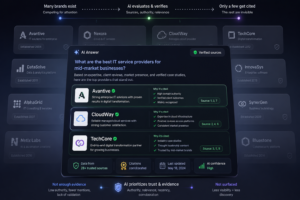
Imagine this. Your pillar page ranks #1 on Google. It’s backed by original research, authoritative links, and years of optimization. You open ChatGPT or Perplexity and ask a question your page should answer better than anyone else. Your competitor gets cited. You don’t.
At Search Signal Lab, we’ve seen this pattern often enough during AI visibility reviews that we’ve given it a name: the Ghost in the Machine effect. It’s the gap between traditional search visibility and AI visibility.
If you’re trying to understand how to get cited in ChatGPT, you’ve probably realized that strong Google rankings don’t automatically translate into AI visibility. During our audits of B2B SaaS websites, we regularly find brands that dominate traditional search but remain invisible across AI-generated answers. At Search Signal Lab, we help SaaS companies bridge that gap by aligning traditional SEO with AI search visibility.
The difference isn’t always authority. More often, it’s how easy your expertise is for AI systems to recognize, retrieve, and reinforce.
The Problem: When Great Content Becomes Hard to Cite
Most pillar pages were built for human readers and traditional search engines. They tell a compelling story, build context, and gradually reveal key insights. That’s excellent for engagement and SEO. AI assistants, however, often perform better when important information is explicit, well-structured, and immediately answerable.
If your best definition only appears after 800 words of context, you’re asking an AI system to do more interpretation before it can confidently reuse your content. That doesn’t mean the page lacks quality. It means the expertise is harder to identify.
The result? You can own Google while remaining virtually invisible in AI-generated responses.
The 3Rs of AI Visibility: How to Get Cited in ChatGPT
When we review AI visibility, we evaluate content using a simple diagnostic framework we call the 3Rs of AI Visibility.
It isn’t a list of ranking factors or a claim about how language models work internally. It’s a practical way to assess whether your expertise is presented in a way that’s easy for AI systems to understand and reference.
1. Recognition
Can an AI immediately recognize what your page is about, and why your brand is a credible source?
Within the opening section of your page, both a reader and an AI assistant should be able to identify:
- the primary topic
- who the content is for
- what problem it solves
- how your business relates to that topic
Avoid clever introductions that delay the answer.
Lead with clarity first, then expand with depth. That’s one of the core principles we apply in our AEO strategy for B2B companies, where the goal isn’t just to rank but to make expertise easier for AI systems to recognize and reference.
The faster your expertise becomes obvious, the easier it is to associate your brand with the subject you’re trying to own.
2. Retrieval
Can AI retrieve a direct answer without interpreting your entire article? One of the most effective improvements is replacing vague or creative headings with the exact questions your audience is asking.
Instead of:
The Evolving Landscape of Scheduling
Use:
What is Automated Resource Scheduling?
Then answer the question immediately in 40–70 words before expanding into examples, implementation advice, or industry context.
Retrieval isn’t just about what your content says—it’s also about how that information is organized. In our experience reviewing B2B SaaS websites, pages with descriptive headings, concise definitions, bullet lists, comparison tables, and a logical information hierarchy are more consistently represented in AI-generated responses than equally informative pages where key information is buried inside long narrative sections.
The goal isn’t to format content for AI. It’s to present expertise in a way that’s easier to understand and reference. Think of every major section as an opportunity to answer a question clearly before exploring it in depth.
3. Reinforcement
One page rarely establishes expertise on its own. AI assistants encounter your content across multiple URLs, not just a single article.
If one page calls your solution resource scheduling, another says workforce allocation, and a third uses entirely different terminology, your topical identity becomes fragmented. The goal isn’t repetition. It’s one of the biggest differences between writing for search engines and building a sustainable AEO strategy for B2B SaaS. It’s conceptual consistency.
Think of it like this.
If you ask five people who “John Doe” is, they’ll all describe him differently. But they’ll probably agree that he’s a chef, lives in Toronto, and specializes in Italian cuisine.
Your content should work the same way. Every supporting article should reinforce the same core concepts around your expertise, even if the wording changes. For a B2B SaaS company, that might mean consistently associating your product with ideas like real-time resource allocation, capacity planning, and cross-project visibility.
Over time, this creates a clearer topical identity across your website, making it easier for AI systems to connect your brand with the subjects you want to be known for.
Read More: How to Write AI search Visibility Prompts?
Why the 3R AI Visibility Matters
Traditional SEO asks: Can this page rank?
AI visibility increasingly asks: Can this information be confidently used to answer a user’s question?
Those are related, but different challenges.
Pages that perform well in AI search don’t just contain useful information.
They present expertise in ways that are easier to recognize, easier to retrieve, and consistently reinforced across an entire content ecosystem.
Across the B2B SaaS websites we’ve reviewed, Recognition, Retrieval, and Reinforcement consistently emerge as the biggest opportunities for improving AI visibility. That’s why they’re central to every AI citation strategy we develop.
From Rankings to Recognition
If you’re trying to figure out how to get cited in ChatGPT, don’t start by asking whether your content is good enough.
- Ask whether it’s easy to recognize.
- Easy to retrieve.
- And consistently reinforced across your website.
That’s the difference between content that simply ranks and content that’s repeatedly referenced.
Google rewards authoritative pages. AI assistants increasingly reward clear, consistent sources. The brands that succeed in AI search won’t necessarily publish the most content. They’ll publish the content that’s easiest to understand, easiest to connect, and easiest to cite.
Find Out Why ChatGPT Isn’t Citing Your Brand
If your pages rank well but your business rarely appears in AI-generated answers, there’s usually a reason.
Our AI Visibility Audit evaluates your content using the 3Rs of AI visibility to identify where AI visibility is breaking down and why your company is not showing up in ChatGpt.
We’ll assess:
- Recognition: Can AI immediately understand what your business is known for?
- Retrieval: Are your answers structured for easy extraction and citation?
- Reinforcement: Does your website consistently build topical authority across every important page?
You’ll receive a prioritized action plan showing which pages to improve first, where your topical signals are inconsistent, and the highest-impact opportunities to increase AI visibility—without sacrificing the SEO performance you’ve already earned.
Book your AI Visibility Audit today and discover what’s preventing your brand from becoming a trusted source in AI search.