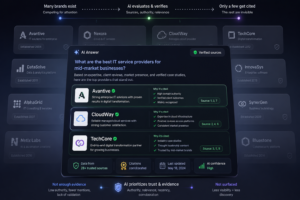

“MQLs no longer capture how B2B buying decisions are formed. Buyers now rely on AI tools, peer validation, and external research long before they convert. This blog explores how content has shifted from lead generation to decision influence.”
For years, B2B content strategy followed a simple model: publish top-of-funnel content, drive traffic, capture MQLs, and convert them into pipeline.
That model still exists; but it’s no longer reliable.
Traffic may hold steady while MQLs stagnate or decouple from revenue. Sales cycles become harder to predict, and content that once drove consistent lead flow stops performing the same way. The issue isn’t demand; it’s that MQLs no longer reflect how buying decisions actually happen.
Buyers now form opinions before filling out a form. They use AI tools, peer discussions, and external platforms to evaluate options long before they reach your site.
By the time they convert, they’re not discovering you, they’re confirming a decision already influenced elsewhere.
Content is no longer just an MQL engine. It’s an influence layer across the buying journey.
What Changed in the MQL Model
The MQL model didn’t disappear, it stopped aligning with how buying decisions actually form. What’s breaking it is not awareness, but sequence and attribution.
Three shifts are driving the gap:
1. MQLs now sit after influence, not discovery
By the time a form is filled, the buyer has usually already:
- compared alternatives
- formed a shortlist
- validated options through AI or peer sources
So the MQL is no longer a signal of early interest—it’s a signal of late-stage confirmation.
2. Content influence is happening in systems you don’t track
A large portion of evaluation now happens outside owned channels:
- AI-generated answers shaping first impressions
- Reddit and community threads framing perception
- Review sites and comparison lists defining credibility
None of this shows up in your analytics stack—but it directly shapes pipeline quality.
3. Attribution breaks at the point of decision formation
MQL systems assume a traceable path from content → form fill.
In reality, the decision is often formed across multiple touchpoints:
- AI summary
- peer validation
- product comparisons
- indirect brand exposure
By the time attribution kicks in, the decision has already been made.
Result: MQLs measure capture, not influence
MQL volume still measures whether someone raised their hand.
It no longer measures whether your content shaped the decision to do so.
Shift From Funnel Thinking to Decision Influence
1. Stop Thinking About Leads as the Primary Goal
Top-of-funnel content isn’t dead, but it shouldn’t exist solely to generate form fills.
Instead, focus on:
- Answering buyer questions wherever they are asking them
- Building trust and authority before a lead converts
- Capturing intent, not just contact information
For example, a product comparison blog might never generate a form fill, but an AI tool could pull that content into an answer for a buyer, who then references it internally. That’s influence, not an MQL, but it drives pipeline.
2. Map Content to Buyer Intent, Not Funnel Stage
Traditional TOFU/MOFU/BOFU mapping assumes a linear journey. Buyers today bounce between stages and use multiple platforms before converting.
Instead:
- Audit content by intent type: informational, comparison, decision-ready
- Identify high-intent content that drives engagement, even without conversions
- Optimize pages for next steps, not just form fills (e.g., live chat, instant demos)
Example: a deep-dive integration page may not get form submissions but shows repeat visits and engagement with pricing content. That’s valuable influence.
3. Invest in Content That Supports Multiple Paths to Conversion
Buyers interact across channels:
- Organic content for discovery
- AI tools and answer engines for instant insights
- Peer communities for validation
- Social and video snippets for bite-sized learning
Your content strategy should enable all these touchpoints. Don’t force a single lead capture moment—let intent convert naturally through conversation, demo requests, or direct outreach.
4. Measure Impact Beyond MQLs
If your KPI is only form fills, you’ll miss real ROI. Instead, track:
- Pipeline influenced by content
- Return visits and multi-page sessions
- Engagement with interactive tools (calculators, comparison charts)
- Conversations initiated through chat, LinkedIn, or direct contact
These metrics reflect where content drives actual decisions, not just clicks.
5. Embrace Agile, AI-Friendly Content Creation
Buyer questions are evolving faster than ever—especially with AI summarizing information instantly. That means content created six months ago might already feel outdated to a prospect asking a similar question today.
Here’s how I approach it:
- Listen to the data constantly – Use SEO trends, search analytics, and even AI query logs to spot emerging questions before they become common.
- Format content for AI consumption – Clear headings, structured data, FAQs, and concise answers make it easier for LLMs to surface your content.
- Keep high-value pages fresh – Update guides, product deep-dives, and comparison content regularly. Even small updates signal relevance to both humans and AI.
- Experiment with diverse formats – Blogs are great, but calculators, interactive guides, video snippets, and one-page explainers often capture attention where static content doesn’t.
The goal isn’t more content; it’s better content, faster, and visible wherever buyers are asking questions. Agility isn’t just marketing jargon, it’s survival.
6. Align Content With Sales
Sales sees the same trend: buyers arrive informed and skip traditional touchpoints.
- Map content to sales enablement needs
- Provide assets that support conversations at any stage
- Track influence of content even when no MQL is generated
Marketing now drives revenue influence, not just lead volume.
Final Thought
MQLs are no longer the whole story. Buyer behavior has shifted; intent happens across AI platforms, communities, and repeat visits.
Top-of-funnel content still matters, but its ecosystem has expanded. It’s no longer just your website; it’s anywhere buyers are asking questions.
The most effective content strategies today:
- Optimize for AI and multi-platform discoverability
- Deliver immediate, actionable answers
- Enable multiple paths to engagement
- Measure pipeline influence, not just MQLs
- Stay agile and aligned with sales
Because in modern B2B, content isn’t just about generating leads—it’s about shaping decisions wherever intent surfaces.