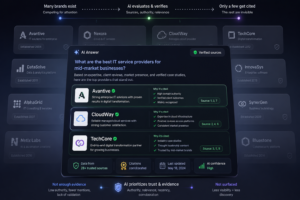

Writing AI search visibility prompts that actually reveal something starts with buyer scenarios, not keywords. Here’s the design process behind AI Search Pulse’s 49-prompt library, 5 categories mirroring how real buyers evaluate software, why the same prompts run every month for comparability, and why we don’t publish the full list.
When we started building AI Search Pulse, the first instinct was to ask AI assistants something like “What’s the best document processing software?” That instinct was wrong, and figuring out why shaped everything about how we built the prompt library.
Generic prompts don’t represent how buyers actually evaluate software. Nobody making a real purchasing decision types “best document AI.” They arrive with a specific problem: a CIO building a shortlist for a Fortune 500 rollout, a developer choosing between APIs, an operations lead automating invoice processing. Each of these people would ask an AI assistant a completely different question, and get a completely different answer.
So instead of one broad prompt, we built a library of 49 prompts, organized around the actual buying journey rather than a keyword list. Here’s how that process worked, category by category.
AI Search Pulse is an independent research initiative from Search Signal Lab focused on measuring AI visibility for enterprise software vendors. Through standardized buyer prompts and monthly benchmarking, we study how conversational AI assistants such as ChatGPT recommend vendors during software evaluation. Learn more about our approach to AI Visibility, ChatGPT Visibility, and LLM Visibility.
Start with the buyer, not the keyword
The core discipline behind every prompt in the library is the same question, asked before writing a single word:
“What problem is this specific buyer trying to solve?”, not “what would someone search for.”
That distinction sounds subtle, but it produces very different prompts. A keyword-style approach would generate something like “best OCR software.” A buyer-scenario approach generates something like: “Our procurement team needs to automate purchase orders, supplier documents, and invoices. Which intelligent document processing platforms are best suited for this workflow?”
The second version does something the first can’t: it tells the AI assistant (and us) exactly what capability is actually being evaluated, who’s asking, and what stage of the buying process they’re in.
Prompt Design Principles
Every prompt included in the AI Search Pulse benchmark is evaluated against the same four design principles before it becomes part of the library:
- Buyer-first, not keyword-first — Every prompt begins with a realistic enterprise buying scenario rather than a generic search phrase.
- One business problem per prompt — Each prompt is designed to evaluate a specific decision or capability, avoiding multiple questions in a single scenario.
- Representative of real evaluation scenarios — Prompts are based on situations that enterprise buyers, technical evaluators, or operations teams are likely to encounter during software selection.
- Consistent over time — Once included in the benchmark, prompts remain stable across benchmark periods so results can be compared meaningfully over time.
Why the same 49 prompts, every month
This library isn’t a one-time snapshot. The same 49 prompts are run every month, unchanged, against the tracked AI model. That consistency is deliberate: if the questions shift from month to month, so does the meaning of any change in results, you’d have no way to tell whether a vendor’s visibility actually moved, or whether we simply asked something different. Keeping the prompt set fixed is what turns a single benchmark into a longitudinal record, and it’s the reason each new monthly report is directly comparable to the last.
The five prompt categories
Every prompt in the library falls into one of five categories, each representing a distinct buyer persona and a distinct thing we’re trying to measure.
1.Enterprise Platform Selection, asked by CIOs, VPs of Operations, and digital transformation leads evaluating platforms for large-scale rollouts.
“If you were advising a Fortune 500 company on selecting an intelligent document processing platform, which vendors would you shortlist and why?”
This category measures category authority, whether a vendor is part of the default enterprise conversation at all.
2.Use-Case and Industry-Specific, asked by operations teams and industry specialists solving a defined workflow problem, sometimes generic (invoices, contracts, claims) and sometimes tied to a specific vertical (insurance, healthcare, banking, logistics, government).
“Our healthcare organization needs to process patient records, medical forms, and clinical documents. Which enterprise document processing platforms should we evaluate?”
This category measures use-case and vertical relevance, whether a vendor shows up when the question gets specific, not just generic.
3.Developer and API Evaluation, asked by engineering teams assessing technical fit before building on top of a platform.
“Which intelligent document processing platforms provide the best developer APIs and SDKs?”
This category measures developer visibility and technical credibility, which often looks completely different from enterprise visibility for the same vendor.
4.Complex Document Understanding, asked by technical evaluators testing the edges of what a platform can actually do.
“Which document AI platforms handle complex layouts and extract tables from PDFs?”
This category measures depth of technical capability, not just brand recognition.
5.Competitive and Alternative Searches, asked by buyers actively comparing vendors or replacing an existing one.
“What are the best ABBYY alternatives?”
This category measures competitive capture, whether a vendor gets named when a buyer is actively shopping away from someone else.
Why “why would a buyer ask this” matters
For every prompt, we documented one more thing before it made it into the library: the reasoning behind it. Not just what the prompt says, but who’s asking, what stage of evaluation they’re in, and what capability the question is actually testing.
This step matters because it’s the filter that keeps the library honest. A prompt doesn’t get included because it sounds plausible. It gets included because it maps to a real moment in a real buying process. If we can’t articulate why a specific buyer would type this specific question, the prompt doesn’t belong in the benchmark.
Where the language comes from
Buyer language doesn’t come from guessing. Prompts are built and cross-checked against where real evaluation conversations actually happen: review platforms like G2, Capterra, and TrustRadius; developer communities like Stack Overflow and GitHub Issues; forums like Reddit, where people ask blunt, unfiltered questions about vendor problems; search behavior patterns like autocomplete and “People Also Ask”; and vendor documentation and demo content, which reveals the technical vocabulary buyers pick up during evaluation.
Cross-referencing these sources against each other is what keeps the prompt library grounded in how buyers actually talk, rather than how marketers describe products.
What we’re not publishing, and why
The full 49-prompt benchmark library is not publicly disclosed in full. That’s a deliberate methodological decision, not an oversight.
The value of a longitudinal benchmark depends on the prompt library remaining both consistent and independent of the vendors being measured. Publicly disclosing the complete benchmark prompt set could unintentionally encourage optimization around those specific questions over time, making the benchmark increasingly reflective of who optimized for the published prompt library rather than broader AI recommendation behavior. Maintaining a fixed prompt library that is not publicly disclosed in full helps preserve the consistency and comparability of benchmark results across reporting periods. This is a methodological safeguard rather than a marketing decision.
What we are sharing, here, and in the full Research Methodology, is the design logic itself: the categories, the reasoning behind each one, and representative examples like the ones above. That’s enough to evaluate whether the approach is sound, without handing out the answer key.
If you’re a tracked vendor, a researcher, or a journalist and want to verify the full prompt library for accuracy, it’s available on request. Reach out and we’re happy to share it privately.
What this means in practice
The prompt library is the research instrument behind every AI Search Pulse benchmark. When a vendor sees a category-level finding, strong in developer prompts, absent in enterprise prompts, for example, that finding traces back to a deliberate design decision: different buyer personas ask different questions, and vendor visibility is rarely uniform across them.
That’s the whole point of building it this way. A single generic prompt would have told us whether a vendor gets mentioned. A structured library built around real buyer scenarios tells us where a vendor is visible, where it isn’t, and why, which is the difference between a curiosity and something a marketing team can actually act on.
For the full picture of how these prompts feed into scoring and reporting, see the AI Search Pulse Research Methodology and our first Document AI / IDP Baseline Report.