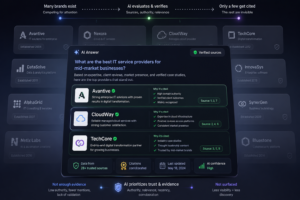

“AI visibility tools like Profound, AthenaHQ, Otterly AI, and Rankscale are emerging to help brands understand how often they appear in AI-generated answers. While some focus on simple monitoring, others are building deeper competitive intelligence platforms for the growing AI search ecosystem; a category that’s still evolving rapidly.”
Understanding AI Visibility Tools Through Use Case and Maturity Level
AI visibility tools like Profound, AthenaHQ, Otterly AI, and Rankscale are emerging to help brands understand how often they appear in AI-generated answers. While some focus on simple monitoring, others are building deeper competitive intelligence platforms for the growing AI search ecosystem, a category that is still evolving rapidly.
Because this market is still early, most understanding of these tools comes from public reviews, user-generated feedback, product positioning, and early adopter discussions. This comparison reflects those emerging perceptions and real-world use cases rather than definitive rankings, an approach aligned with how we at Search Signal Lab interpret early signals in evolving discovery systems.
AI search is changing how people discover brands. Instead of relying only on traditional search rankings, users are now getting answers directly from systems like ChatGPT, Perplexity, Gemini, and Google AI Overviews.
Deep AI Visibility & Competitive Intelligence
This category represents the most advanced layer of AI visibility tools.
These platforms are built for teams that want to understand how their brand appears across AI engines at a granular level — and how that compares to competitors over time.
What they’re strong at:
- tracking visibility across prompts and AI engines
- competitive benchmarking inside AI-generated answers
- identifying shifts in brand mentions over time
- surfacing patterns behind visibility changes
What users tend to value:
- high data granularity
- strong competitor intelligence
- visibility into model-level differences
Where they start to break down:
- requires experience interpreting AI visibility data
- dashboards can feel heavy for smaller teams
- limited guidance on next steps or actions
- ROI is harder to justify unless AI search is a core channel
Fit boundary:
These tools work best when AI visibility is already a core growth channel, not an experimental one. If you’re still trying to understand whether AI search matters, this category is usually too advanced.
Simple AI Visibility Monitoring
Otterly AI
This category focuses on lightweight tracking rather than deep analysis. It’s often the first step for teams entering GEO or AI visibility monitoring.
What it does well:
- fast setup and low friction onboarding
- simple visibility snapshots across AI engines
- quick confirmation of brand presence in AI answers
- easy dashboards that don’t require training
What users like:
- simplicity and clarity
- low commitment to get started
- useful for early experimentation
Where it becomes limiting:
- does not explain why visibility changes happen
- limited strategic or competitive depth
- not designed for scaling into advanced workflows
- can feel shallow once teams mature
Fit boundary:
Best suited for a simple question:
“Are we showing up in AI answers or not?”
Not designed for optimization or strategic planning.
SEO-to-GEO Transition Tools
Rankscale
This category sits between traditional SEO workflows and AI-native visibility tracking. It is designed for teams still thinking in SEO terms but beginning to adapt to AI-driven search behavior.
What it’s strong at:
- familiar SEO-style interface
- easier adoption for SEO-led teams
- blends keyword logic with prompt-based tracking
- useful for structured reporting and comparisons
What users notice:
-
- smoother learning curve than AI-native tools
- comfortable transition for SEO-focused teams
- works well for reporting visibility trends
Where it falls short:
- still rooted in SEO mental models rather than AI-native behavior
- limited understanding of how AI systems select or cite sources
- weaker strategic guidance beyond reporting
- not fully aligned with AI discovery dynamics
Fit boundary:
Works best as a transition layer, not a long-term end state. It helps teams move from SEO thinking into AI search thinking, but does not fully replace either.
Start tracking your presence across AI platforms today.
See our free AI visibility measurement framework.
What Early Users Actually Agree On
Across tools like Profound, AthenaHQ, Otterly AI, and Rankscale, early feedback converges into consistent patterns.
What users consistently value:
- visibility tracking across AI platforms is directionally useful
- competitor benchmarking is one of the strongest use cases
- prompt-level insights feel new and strategically meaningful
- early signals help guide content and positioning decisions
What users consistently struggle with:
- most tools are monitoring-first, not action-first
- unclear connection between visibility and revenue impact
- AI outputs fluctuate, making tracking inconsistent
- too many dashboards, not enough prioritization
- pricing often reflects early-stage maturity
The core pattern is simple:
These tools show patterns, not prescriptions. They help you understand what is happening, not fully what to do about it.
Simple Comparison View (Category Logic)
| Category | Tools | Best For | Strength | Limitation |
| Deep AI Intelligence | Profound, AthenaHQ | Advanced teams treating AI search as a core channel | Depth + competitive insight | Complexity + limited action guidance |
| Lightweight Monitoring | Otterly AI | Early-stage validation | Simplicity + fast setup | Limited depth or strategy |
| SEO → GEO Transition | Rankscale | SEO teams evolving into AI search | Familiar workflows | Not fully AI-native |
Which Type of AI Visibility Tool Actually Fits You
Most confusion in this space comes from comparing tools built for different maturity levels. A clearer way to choose is based on where you are in your AI search journey.
If you’re just exploring whether AI visibility matters
→ Use lightweight monitoring tools like Otterly AI
Focus is awareness, not optimization. You’re simply checking whether your brand appears in AI answers.
If AI search is becoming strategically relevant
→ Use SEO-to-GEO transition tools like Rankscale
This is the bridge phase where SEO workflows still apply, but AI visibility becomes part of tracking and reporting.
If AI visibility is a core growth channel
→ Use deeper intelligence platforms like Profound or AthenaHQ
At this stage, tracking is not enough. Focus shifts to:
- competitive positioning in AI answers
- prompt-level visibility changes
- cross-model behavior patterns
The key question becomes: “Why are we visible or not?”
If you’re still uncertain about priority
→ Avoid complex platforms for now
Most teams overbuild too early. Basic tracking is usually enough until strategy matures.
Further reading: Why Prompt Libraries Fail
Conclusion
AI visibility tools are still early-stage infrastructure.
They are best used for:
- detecting whether your brand appears in AI answers
- understanding competitive presence in AI-generated results
- identifying content gaps across AI systems
But they are not yet:
- full attribution systems
- optimization engines
- or complete measurement frameworks
So the most accurate way to think about them is:
They are directional intelligence tools for an emerging discovery layer. Not finished systems, but early signals in a system still forming. In this environment, advantage does not come from perfect data. It comes from faster interpretation of imperfect signals.
Search Signal Lab exists to track those signals before they become obvious.