
TL;DR: Key Takeaways
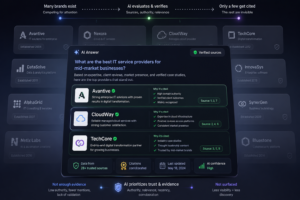
- Traffic is no longer the best signal of content performance. AI is reshaping discovery into a zero-click, answer-first journey where visibility across the funnel matters more than website visits.
- Buyers now start with AI , asking questions, comparing tools, and forming opinions before they ever click a link.
- Top-of-funnel content is no longer just about traffic, it’s about visibility inside answers.
- Mid-funnel content (comparisons, “best tools,” case studies) is what AI relies on to build shortlists, if you don’t create it, someone else shapes your narrative for you.
- Bottom-of-funnel content (pricing, feature breakdowns, FAQs) is where AI helps users make final decisions.
- What’s missing from most strategies: a strong point of view, first-party data and proof, consistency across the funnel, content designed around questions, and distribution beyond your own website.
Why Is Organic Traffic Dropping Despite Stable Rankings?
For a long time, content strategy followed a familiar playbook: create top-of-funnel content, rank on search, drive traffic, and convert a portion of that traffic into leads. Blogs, guides, and checklists all pointed back to your website. That model still works, but it’s no longer the full picture.
You can have steady traffic and still see pipeline stall. You can publish consistently and still struggle to connect content to revenue. The issue isn’t always performance. It’s that the journey itself has changed. More often now, buyers aren’t starting on your website.
They’re starting with AI.
They’re asking questions, comparing tools, and forming opinions before they ever click a link. By the time they land on your site, they’re not discovering you; they’re evaluating you. And that shift changes what your content needs to do across the entire journey.
Search Signal Lab helps companies build content systems designed for AI visibility and buyer influence.
Where Does Content Fit Now: From Discovery to Decision?
AI tools don’t just help people find information—they shape how that information is understood.
- They summarize your blog posts.
- They compare your product to competitors.
- They interpret your pricing and positioning.
In many cases, they influence whether you even make the shortlist.
So your content isn’t just written for humans anymore. It’s also being parsed, restructured, and surfaced by systems that help users make decisions before they ever reach you.
Top-of-Funnel: Still Important: Just Different
Top-of-funnel (TOFU) content hasn’t lost its value—but its role has shifted. It’s no longer about publishing more. It’s about being useful enough to be included in the answer.
What works now:
| For B2B | For B2C |
|---|---|
| “How to” guides (clear, outcome-driven) | Problem-solving queries (“how to fix,” “how to choose”) |
| Simple explanations of complex concepts | “Best of” and discovery content |
| Step-by-step frameworks | Quick, practical tips |
| Use-case-driven educational content | Visual or skimmable formats |
The key factor is clarity. If your content answers a question directly and quickly, it’s far more likely to be picked up and reused. TOFU is no longer just about traffic—it’s about visibility inside answers.
Mid-Funnel: Where Is Consideration Shaped?
This is where many teams fall short, and where AI has the most influence. Buyers are increasingly getting shortlists from AI before they ever visit a website. And those shortlists are built from content that clearly explains differences.
If you’re not creating that content, someone else is shaping your narrative for you.
This is why you need more:
- Comparison pages (X vs Y)
- “Best tools” and alternatives content
- Industry-specific or use-case pages
- Case studies with clear, measurable outcomes
This is the content AI relies on to answer:
- Who is this for?
- How is it different?
- When should I choose it?
If your positioning isn’t obvious, it won’t show up clearly in AI-generated responses either.
Bottom-of-Funnel: Why Is It the Most Underrated Layer?
BOFU content is often treated as an afterthought. That’s a mistake. This is exactly where AI helps users make decisions.
People are asking:
- “Is this worth the price?”
- “Which plan should I choose?”
- “Does this actually fit my needs?”
And the quality of those answers depends entirely on your content.
What actually helps:
- Transparent pricing pages
- Detailed product breakdowns
- Feature comparisons
- Objection-handling FAQs
If your pricing is vague or your product pages are generic, AI doesn’t have much to work with. But when your content is specific and structured, it becomes easier for AI to:
- Match you to the right use case
- Explain your value clearly
- Reinforce a decision in your favor
Real-World Use Case: How Does This Play Out for a B2B SaaS Company?
Scenario: A B2B SaaS company selling a CRM for small sales teams.
A potential buyer starts by asking AI:
“What’s the best CRM for a 5-person sales team?”
The AI pulls from:
- “Best CRM tools for small teams” articles (TOFU)
- “CRM A vs CRM B” comparisons (MOFU)
- Case studies showing results for small teams (MOFU)
- Pricing and feature pages (BOFU)
Now imagine two outcomes:
| Company A | Company B |
|---|---|
| Generic blog content | Clear “Best CRM for small teams” guide |
| No comparison pages | Strong comparison pages |
| Vague pricing | Transparent pricing with examples |
| — | Case studies tied to similar team sizes |
Company B is far more likely to:
- Appear in the initial answer
- Be included in comparisons
- Be recommended as a fit
By the time the buyer clicks through, they’re already leaning toward Company B.
That’s the difference: content didn’t just attract the user, it shaped the decision before the visit.
What Formats Work in an AI-Driven World?
Some formats consistently perform better—not because they’re trendy, but because they’re easy to extract and trust:
- Clear headings and logical structure
- Short, direct answers
- FAQ sections
- Comparison tables
- Summaries and key takeaways
These formats make it easier for both humans and AI to understand and reuse your content.
What’s Missing (and What to Add)?
Most teams adapting to this shift still overlook a few critical pieces:
1. Strong Point of View: A lot of content is neutral and generic. That doesn’t stand out—either to readers or AI. You need clear positioning:
- Who you’re for (and not for)
- What makes you different
- When someone should choose you
2. First-Party Data and Proof: AI favors content that feels credible.
- Original insights
- Real numbers
- Specific outcomes
Case studies shouldn’t just tell stories—they should show results.
3. Consistency Across the Funnel: Many companies invest heavily in TOFU but neglect MOFU and BOFU. That creates gaps in the journey, and weakens how AI represents you.
4. Content Designed for Questions: Think less in terms of “topics” and more in terms of:
- What questions are buyers asking at each stage?
- Do we answer them clearly and directly?
5. Distribution Beyond Your Website: Your content shouldn’t live only on your blog. Repurpose it into:
- Community discussions
- Social posts
- Third-party platforms
The more places your content appears, the more signals AI has to work with.
Suggested Read: AI SEO Mythbusters #1: The “Smart” Keyword Strategy That Can Kill Revenue
The Real Shift: From Traffic to Influence
What’s changing isn’t just where content shows up—it’s how it contributes.
A buyer might:
- Discover you through an AI-generated answer
- Evaluate you through comparison content
- Validate you through your pricing page
- Convert later—without ever filling out a form
Content isn’t just driving traffic anymore. It’s shaping perception, building trust, and influencing decisions—often invisibly.
Final Thought
Entry-level content still matters. But it’s no longer the center of your strategy. Your content now works as a system; the one that helps AI understand:
- Who you are
- How you’re different
- When you should be recommended
So the better question isn’t:
“Are we creating enough content?”
It’s:
“Is our content clear enough, specific enough, and useful enough to influence decisions; before someone even lands on our site?”