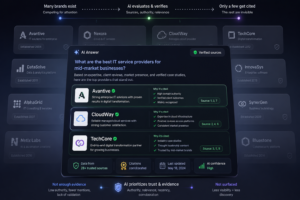

Methodology Version 1.0
Executive Summary
AI Search Pulse is an ongoing research program that measures how AI assistants recommend enterprise software vendors in response to real buyer evaluation questions. Each benchmark tracks a defined set of enterprise software vendors within a specific industry category, using a fixed library of buyer-representative prompts, run on a consistent schedule. This document defines the research objective, scope, design, metrics, principles, and limitations of the program.
Research Objective
The objective of AI Search Pulse is to measure enterprise software vendor visibility in AI-generated recommendations, and to track how that visibility changes over time.
The program does not evaluate product quality, customer satisfaction, or market share. It evaluates a single, specific phenomenon: whether and how often a vendor is named by an AI assistant in response to a defined set of buyer-representative questions.
Why This Research Exists
AI assistants are increasingly used during software discovery and evaluation. While adoption patterns continue to evolve, many enterprise buyers now use conversational AI to explore vendors, compare products, and understand capabilities before engaging directly with suppliers.
While some search platforms have begun introducing reporting for AI-powered search experiences, organizations still have limited visibility into how standalone AI assistants recommend vendors during software evaluation. AI Search Pulse focuses on this broader landscape by measuring enterprise software vendor visibility across conversational AI assistants using a standardized research methodology.
Why Intelligent Document Processing?
Intelligent Document Processing was selected as the initial benchmark category because it represents a mature enterprise software market with a diverse competitive landscape, well-defined buyer personas, and a high volume of document-centric evaluation scenarios. The category provides an appropriate environment for establishing and validating the AI Search Pulse methodology before expanding into additional enterprise software markets.
Research Scope
| Scope | Version 1.0 |
| Industry | Intelligent Document Processing |
| Vendors tracked | 10 |
| Models tracked | ChatGPT |
| Prompt library | 49 buyer evaluation scenarios |
| Frequency | Monthly |
Additional industry categories and additional AI models are expected to be added as the program matures. Each addition will be documented in Version History.
Research Design
Each benchmark begins with the selection of a single industry category and a defined set of enterprise software vendors representing the primary competitive set within it. A fixed library of prompts is then constructed to represent realistic buying scenarios across five categories: enterprise platform selection, use-case and industry-specific scenarios, developer and API evaluation, and competitive or alternative-vendor comparisons.
The same prompt library is submitted to the tracked AI model(s) on a fixed monthly schedule. For each response, the research records which vendors are mentioned, the order in which they appear, and the category of the originating prompt.
The benchmark is based on a standardized prompt library designed to represent realistic enterprise software buying scenarios. Additional information about the prompt design methodology is available in our companion article.
Metrics Tracking
AI Visibility Score — a composite metric used to quantify a vendor’s visibility across the benchmark. Version 1.0 is primarily based on recommendation frequency, with future versions expected to incorporate additional signals such as recommendation order or prominence.
Category Distribution — visibility broken out by prompt category, allowing visibility to be assessed separately for different buyer personas (for example, enterprise buyers versus developers) rather than as a single aggregate figure.
Recommendation Order — the position in which a vendor is mentioned within a given response, tracked as a secondary signal alongside frequency.
For examples of these metrics applied to real results, see the latest baseline report.
Applications of This Research
AI Visibility Score and Category Distribution are designed to surface specific, actionable gaps rather than a single aggregate ranking. In practice, these metrics typically point to three categories of gaps:
- Audience gap — a vendor may be highly visible in one buyer persona’s prompts (for example, developers evaluating APIs) while nearly absent in another (for example, enterprise buyers building a shortlist). This indicates uneven visibility across the buying committee, not a single visibility problem.
- Differentiation gap — a vendor consistently appearing alongside the same competitors, with similar framing, indicates that AI assistants are not distinguishing that vendor’s specific strengths from the surrounding category. This is a positioning signal rather than a visibility signal.
- Content gap — a vendor absent from a category where it plausibly competes typically reflects insufficient content establishing that relevance, rather than a deliberate exclusion by the AI model.
These categories provide a starting framework for interpreting benchmark results. For applied examples using real findings, see the latest baseline report and related case studies.
Research Principles
AI Search Pulse is guided by the following principles:
- Transparency — the research objective, scope, and design are documented and available to any reader or vendor referenced in the research.
- Repeatability — the same prompt library and process are used consistently, so that results can be compared across time periods.
- Neutrality — vendor inclusion and prompt design are based on category relevance, not commercial relationship.
- Consistency — methodology changes are versioned and documented rather than applied retroactively.
- Continuous observation — the research is designed to run on an ongoing basis, producing a longitudinal record rather than a single snapshot.
- Public methodology — the research design, scope, and any material methodological changes are documented publicly.
In Scope / Out of Scope
| In Scope | Out of Scope |
| AI-generated recommendations | Product reviews |
| Vendor visibility | Product quality |
| Buyer evaluation scenarios | Customer satisfaction |
| Longitudinal trends | Market share |
| Prompt-based benchmarking | Analyst rankings |
Research Limitations
This measures AI recommendation visibility, not product quality. A vendor’s AI Visibility Score reflects how often it is mentioned by an AI model in response to the tracked prompt set; it does not independently assess product performance, customer satisfaction, or suitability for any particular use case.
Results are based on a fixed, defined prompt library specific to each tracked industry category. Using a consistent set of prompts over time is intended to make period-over-period comparison meaningful, since changes in results are more likely to reflect changes in AI-generated responses rather than changes in the questions asked.
AI models are updated on schedules outside this program’s control. A change in a vendor’s AI Visibility Score may reflect a change specific to that vendor, or it may reflect a broader model update affecting how all tracked vendors are discussed. Known model updates are noted in the relevant report when identified.
This research measures relative visibility within its defined methodology. It does not represent a measure of overall market share, revenue, customer base, or industry-wide leadership, which are distinct measurements produced through different methods.
What This Benchmark Is — and Isn’t
AI Search Pulse measures enterprise software vendor visibility across a standardized set of buyer evaluation prompts. The benchmark reflects AI assistant recommendations for this prompt library and is not a measure of product quality, customer satisfaction, or overall market leadership.
Intended Audience
AI Search Pulse is designed for:
- Enterprise software vendors
- Marketing and brand teams
- Product marketing leaders
- SEO and AI search practitioners
- Industry analysts and researchers
Version History
- Methodology Version 1.0 (July 2026) — Initial methodology. Scope: Intelligent Document Processing, 10 enterprise software vendors, ChatGPT, 49 prompts, monthly frequency.