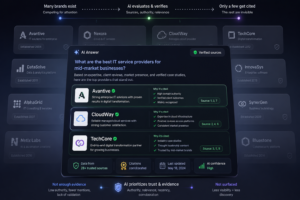

TL;DR: Ranking on Google is no longer enough. Learn how AI-powered search is changing brand discovery, what AI visibility means, and how to measure success beyond traditional traffic and rankings.
“The new mandate for marketers: Optimize not just for humans, but for the systems that shape human decisions.”
What happens when your brand ranks on Google but never gets mentioned by AI? As search evolves from a list of links into a layer of AI-generated recommendations, visibility is being determined by a new set of systems. ChatGPT, Google AI Overviews, Perplexity, and Claude are increasingly influencing which brands enter the consumer’s consideration set, and which are left out entirely.
This shift is forcing marketers to rethink how they measure search success, protect brand visibility, and earn recommendations in an AI-first world. At Search Signal Lab, we help brands understand and improve their AI visibility through data-driven GEO, AEO, and AI SEO strategies designed for the next generation of search.
The Public Discourse: How the Industry is Defining the Problem
If you look at discussions on LinkedIn, Reddit (like r/SEO), and marketing communities, the anxiety is palpable. The public conversation generally falls into three camps:
- The “Zero-Click” Panic: Marketers are watching organic traffic plateaus or dips, even while their keyword rankings hold steady. Because AI engines synthesize information directly on the platform, users get what they need without ever clicking through to a website.
- The Black Box Frustration: In traditional SEO, tools tell you exactly who ranks where and why. In GEO, responses can be highly personalized, probabilistic, and variable. Marketers feel blind trying to figure out why a competitor was cited instead of them.
- The Narrative & Hallucination Risk: Public forums are full of horror stories where an LLM pulls outdated data, blends product specifications with a competitor’s, or misrepresents a brand’s core offering entirely because it lacked clean, structured data to read.
The Coexistence Framework: Intent-Driven Search Layers
To move past this panic, marketing teams must understand a fundamental truth: AI Overviews, GEO, and AEO are not arriving to completely devour traditional SEO. They are not zero-sum rivals fighting for real estate. Instead, they coexist as distinct layers of a single, mature digital ecosystem designed to deliver the ultimate user experience (UX) based entirely on user expectation and intent.
[ USER INTENT / QUERY ]
│
┌────────────────────┼────────────────────┐
▼ ▼ ▼
[ Speed & Fact ] [ Context & Nuance ] [ Action & Task ]
│ │ │
▼ ▼ ▼
Traditional SEO AI Overviews / GEO AEO / Agents
(Direct Web Clicks) (Synthesized Answers) (Autonomous Actions)
Search Signal Lab’s AI SEO / GEO optimization services are designed to help brands perform across all three layers of search
Think of it as a user-experience funnel driven by the complexity of the query:
- The Traditional SEO Layer (High-Intent Navigational/Transactional):
When users search for a specific product, business, or website, they want a direct path to the information, not an AI-generated summary. Traditional SEO ensures your transactional and navigational pages remain easy to find and access when users know exactly what they’re looking for. - The GEO / AI Overview Layer (Informational & Synthesized):
When users ask complex questions that require comparison, research, or expert guidance, they want answers, not links. AI Overviews and GEO help brands surface within AI-generated summaries that synthesize information from multiple sources into a single response. - The AEO Layer (Task-Oriented & Delegated):
When users ask AI assistants to complete a task—such as finding software, booking travel, or making recommendations—they often skip research altogether. Agentic Engine Optimization (AEO) helps ensure your data, products, and services are structured in ways AI agents can understand and act upon.
Ultimately, these technologies are filtering traffic so that the right user arrives at the right destination. Traditional SEO handles direct navigation, GEO handles deep research, and AEO handles seamless execution.
The Core Conflict: Visibility Vs. Traffic
For years, SEO success was measured by rankings, clicks, and sessions. AI search introduces a new reality: a brand can influence a buying decision without receiving a visit.
This creates a challenge for marketing teams. Traditional SEO is still responsible for driving discoverability and traffic, while GEO focuses on earning visibility within AI-generated answers. As search evolves, success can no longer be measured by traffic alone. Brands must learn to optimize for both attention and attribution.
Traditional SEO vs. AI SEO (GEO)
| Dimension | Traditional SEO | AI SEO / GEO |
| Primary Goal | Rank on page one of Search Engine Result Pages (SERPs). | Earn citations and synthesis within AI-generated answers. |
| Core Mechanics | Keyword density, URL structure, site speed, and link equity. | Contextual relevance, entity clarity, and machine-readability. |
| Content Format | Long-form comprehensive guides optimized for human skimming. | Direct answers, scannable lists, micro-summaries, and explicit definitions. |
| Discovery Channel | Crawlers indexing public web pages. | LLMs consuming structured feeds, trusted third-party media, and clean HTML. |
The Integration Strategy
To succeed across the entire user experience, marketing teams must execute both approaches simultaneously:
- Ensure Machine Legibility: If your content relies heavily on client-side JavaScript rendering, or sits behind complex accordion elements, AI crawlers often miss it. The technical foundation now requires server-side rendering and flawless Schema markup.
- Optimize for “Information Extraction”: Structure your pages so an LLM can easily pull facts. This means putting a concise, direct answer at the top of a section (leading with the answer) followed by data points, tables, and structured bullet points.
The New Analytics Framework: True AI SEO Success Metrics
Because traditional clicks and impressions don’t tell the whole story anymore, marketing teams need a new measurement framework. These are the core KPIs that modern marketers must track:
- AI Visibility Score & Share of Voice (SoV): The percentage of times your brand is surfaced across a defined “universe” of high-intent prompts within ChatGPT, Gemini, Perplexity, and AI Overviews.
- Citation Share vs. Unlinked Mentions: Monitoring whether the AI merely names your brand or explicitly drops a hyperlinked citation back to your domain.
- Prompt-Level Performance & Gaps: Zooming into specific micro-competitions (e.g., “What is the best automated inventory software for small e-commerce?”) to see if your product pages appear in the top 3 recommendations.
- Sentiment and Brand Accuracy: Evaluating the context in which the AI discusses your brand. Is it accurately describing your features, or is it hallucinating based on outdated forum data?
- AI Referral Traffic: Isolating traffic coming specifically from AI user agents (like ChatGPT-User) within your web analytics tools.
The C-Suite Translation Layer: How to Present GEO to Executives
Chief Executive Officers and Chief Financial Officers do not think in terms of keyword tracking or semantic density. They care about market share, brand equity, risk mitigation, and revenue. When presenting an AI SEO strategy to leadership, marketers must shift the narrative away from “traffic drops” and toward strategic relevance.
Use this sequential operational framework to guide the pitch to leadership:
1.Shift the Narrative from ‘Traffic’ to ‘Share of Voice’: Context Setting.
Acknowledge that traditional organic sessions may flatten, but explain that this is an industry-wide paradigm shift. Introduce AI Share of Voice as the new metric for market dominance. If your brand isn’t in the AI’s top three recommendations, you are completely excluded from the consumer’s consideration set.
2.Position Content Distribution as ‘Brand Insurance’: Risk Management.
Framing AI SEO purely as a traffic play minimizes its value. Frame it as brand protection. Explain that without clean data structures and authoritative web presence, AI engines will hallucinate or pull inaccurate data about your products. Saturating the web with clear, structured facts is a mandatory brand safety mechanism.
3.Bridge Marketing Silos (PR + Content + SEO): Operational Alignment.
Show the C-suite that GEO breaks down old operational barriers. LLMs lean heavily on institutional trust and third-party validation (like authoritative news sites and industry reviews). Earned media from your PR team acts as the trusted training data that feeds the AI, which the SEO team then optimizes for extraction.
4.Demonstrate Pipeline Impact via High-Intent Prompts: Financial Justification.
Tie prompt-level wins directly to the bottom line. Show screenshots or dashboard data of your brand winning high-intent, bottom-of-the-funnel conversational queries. Prove that while raw top-of-funnel informational traffic might decrease, the users coming through AI citations are deeply qualified and closer to a buying decision.
Suggested Read: AI SEO Mythbusters #1: The “Smart” Keyword Strategy That Can Kill Revenue
The Bottom Line
Search is no longer a list of links. It is a system of recommendations. As AI becomes the primary interface between users and information, visibility, not traffic, becomes the real measure of search success. The question is no longer whether this shift is happening, but whether your brand is visible inside it.
.
You’ve read about AI Share of Voice, citation visibility, and prompt-level performance. But how does your brand actually perform? Get your AI Visibility Score to see where your brand appears across ChatGPT, Gemini, Perplexity, and Google AI Overviews—and uncover the gaps holding you back.